Travelling with a baby or toddler can be a wonderful opportunity to spend quality time together, explore new places and create lasting memories. Whether you’re visiting grandparents, heading to the coast for a weekend, flying abroad or setting off on a long road trip, travelling with young children can be exciting, but it can also bring plenty of questions about sleep.
Many parents worry that a disrupted routine, missed naps or sleeping in an unfamiliar place will undo all the progress they’ve made. If you’ve worked hard to establish healthy sleep habits at home, it’s completely understandable to feel anxious about how travel might affect your baby’s or toddler’s sleep.
The reassuring news is that a holiday doesn’t have to mean the end of good sleep. Children are naturally adaptable, and with a little preparation, realistic expectations and a gentle approach, most families can enjoy their time away while continuing to support healthy sleep habits.
In this evidence-based guide, I’ll share practical tips to help your baby, toddler or preschooler sleep as well as possible during car journeys, flights and family holidays. You’ll also learn how to manage jet lag, maintain familiar routines, follow safer sleep guidance while travelling and gently return to your normal routine once you’re home.
As a paediatric nurse and gentle sleep consultant, I believe holidays should be enjoyed—not spent worrying about every bedtime. My aim is to help you feel confident supporting your child’s sleep while making precious family memories that will last a lifetime.
Table of contents
- Why travelling affects children’s sleep
- Travelling with a Baby: Managing Sleep During Car Journeys
- Helping your child sleep on a plane
- Time zone changes and jet lag
- Safe sleep while travelling
- Returning home after your holiday
- Frequently asked questions
Why Travelling Can Affect Your Child’s Sleep
Travelling brings lots of exciting new experiences, but it also introduces many changes that can temporarily affect sleep. New environments, unfamiliar sounds, different routines, altered meal times and increased stimulation can all make it more difficult for babies and young children to settle.
Young children thrive on predictability. Their internal body clock, known as the circadian rhythm, relies on regular routines and exposure to natural daylight to regulate sleep and wake times. When these routines change, it’s completely normal for sleep to become a little unsettled for a few days.
The reassuring news is that these changes are usually temporary. With gentle support and realistic expectations, most children adapt quickly and return to their usual sleep patterns once they are back home.
Preparing Before You Travel
A little preparation before your trip can make travelling with children much less stressful.
In the days leading up to your holiday, aim to keep your child’s sleep well balanced rather than allowing them to become overtired. Pack familiar bedtime items such as their sleeping bag, favourite comforter, bedtime book or white noise machine, as these familiar cues can help them feel safe in an unfamiliar environment.
If you’re staying away from home, check in advance that your accommodation has a safe sleeping space suitable for your child’s age.
Travelling with a Baby: Managing Sleep During Car Journeys
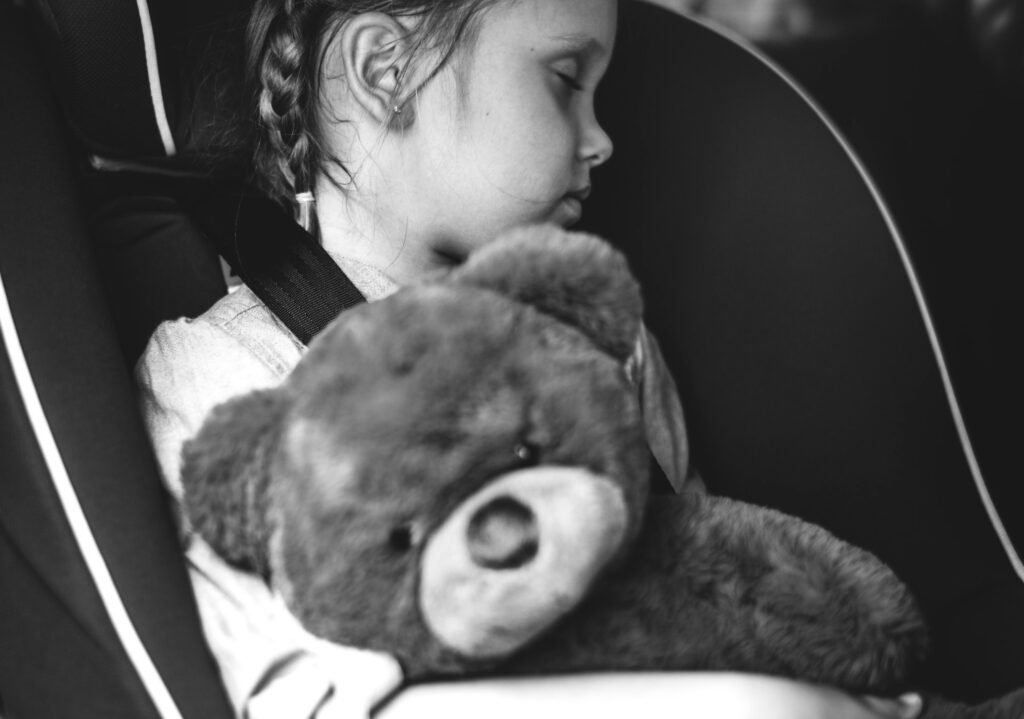
Travelling with little ones can sometimes mean naps on the go.
Long car journeys are often unavoidable when travelling with children. While many parents hope their child will simply sleep the whole way, this doesn’t always happen, and that’s perfectly normal.
Keep Safety the Priority
Although many children fall asleep in the car, remember that car seats are designed for travel rather than routine sleep. Once you arrive at your destination, transfer your baby to a firm, flat sleep surface as soon as it is practical to do so. This follows safer sleep guidance from the Lullaby Trust.
Plan Around Sleep If You Can
If possible, begin your journey around your child’s usual nap time. Many children naturally fall asleep once the car is moving, making the journey more peaceful for everyone.
However, don’t feel pressured to plan every journey around sleep. Sometimes it’s simply not practical, and one shorter or later nap is unlikely to have a lasting impact.
Take Regular Breaks
For longer journeys, schedule regular stops so your child can stretch, move around and have a snack. Fresh air and movement can help reduce frustration, particularly for toddlers and preschoolers.
Avoid Overtiredness
If your child refuses to nap in the car, try to offer an earlier bedtime once you arrive. Overtired children often find it harder—not easier—to fall asleep.
Helping Your Child Sleep on a Plane
Flying with young children can feel daunting, but a little preparation can go a long way.
Encourage Movement During Long Flights
For toddlers and preschoolers, encourage gentle movement when it’s safe to do so. Walking along the aisle, stretching and changing position can help reduce restlessness and make it easier to settle when it’s time to sleep.
Dress Comfortably
Choose loose, breathable clothing and layers that can easily be removed if the cabin becomes warm.
Bring Familiar Comfort Items
When travelling with a baby, keeping a few familiar elements of their usual sleep routine can help them feel secure in an unfamiliar environment. A favourite comforter, muslin, teddy, bedtime book or dummy can provide reassurance during the flight and help your child relax.
Don’t Worry About “Bad Habits”
Many parents ask whether cuddling, rocking or feeding their child to sleep on the plane will undo all their progress.
The answer is almost always no.
Travelling is a unique situation. Providing extra comfort when your child is tired, overwhelmed or in an unfamiliar environment is a responsive and loving way to support them.
Children quickly learn the difference between holiday travel and home routines.
Travelling with a baby can be a wonderful adventure with a little preparation.
Time Zone Changes and Jet Lag
Travelling across several time zones can temporarily disrupt your child’s body clock.
Jet lag happens because the body’s circadian rhythm needs time to adjust to the new light-dark cycle.
Research suggests that daylight exposure is one of the strongest influences on resetting the body’s internal clock.
For Smaller Time Differences (1–2 Hours)
Many families simply adjust naturally within a day or two.
Try to:
- Get outside in natural daylight each morning.
- Offer meals according to local time.
- Follow your usual bedtime routine.
- Be patient while your child adjusts.
For Larger Time Differences
If you’re travelling long haul, consider gradually shifting bedtime by 15–30 minutes for several days before departure if practical.
Once you arrive:
- Spend plenty of time outdoors during daylight hours.
- Keep naps age-appropriate but avoid very long late-afternoon naps.
- Follow local bedtime rather than home time as soon as possible.
Most healthy children adapt within several days.
Holidays Are Meant to Be Enjoyed
One of the biggest sources of stress for parents is worrying that every late bedtime or missed nap will “ruin” sleep.
Thankfully, that’s rarely how children’s sleep works.
Sleep develops over months and years—not over a single holiday.
Enjoy the evening meal.
Watch the sunset together.
Stay a little longer at the beach.
Celebrate a special family occasion.
Sleep may not look exactly the same when travelling with a baby, and that’s okay. Aim for consistency where possible rather than trying to recreate your home routine perfectly.
A flexible approach for a week or two is unlikely to undo healthy sleep habits you’ve built over time.
Children benefit from secure relationships far more than perfectly timed bedtimes every day of the year.
Safe Sleep While Travelling
While flexibility is helpful, safe sleep should always remain the priority.
For babies under 12 months, the UK Lullaby Trust recommends following the same safer sleep practices whether you’re at home or away.
These include:
- Always place your baby on their back to sleep.
- Use a firm, flat mattress in good condition.
- Avoid pillows, quilts, loose blankets and soft toys in the sleep space.
- Ensure the travel cot or cot meets current safety standards.
- Avoid overheating by dressing your baby appropriately for the room temperature.
- Keep your baby’s sleep space smoke-free.
If you’re staying with family or friends, it can be helpful to discuss sleeping arrangements before you arrive so you know your baby will have a safe place to sleep.
For older babies and toddlers, continue to ensure that cots, travel cots and beds are appropriate for their age and development.

Family holidays are a wonderful opportunity to make memories together while supporting your child’s sleep away from home.
Returning Home After Your Holiday
Many parents are surprised by how quickly children settle back into their usual routines.
If sleep has become a little later or naps have changed, don’t panic.
Instead:
Return to Your Normal Routine
Start your familiar bedtime routine on the first evening home.
Children often respond well to familiar cues.
Be Consistent
Consistency is usually far more effective than making lots of changes.
Resume your usual bedtime, wake-up time and nap schedule as closely as possible.
Give It Time
Some children settle immediately, while others need a few days to readjust.
This is completely normal.
Avoid assuming that sleep has been “broken.”
Instead, think of it as helping your child gently find their rhythm again.
Frequently Asked Questions
Will one week away ruin my child’s sleep?
No.
Temporary changes during holidays rarely undo healthy sleep habits. Most children return to their usual routine within a few days of getting home.
Should I skip naps to make bedtime easier?
Usually not.
Overtiredness often leads to more night waking, earlier mornings and difficulty settling.
Is it okay if my child naps in the pushchair?
Yes.
Holiday naps are often more flexible than naps at home. As long as your child is getting enough overall sleep and is sleeping safely, occasional pram or carrier naps are perfectly reasonable.
My child only wants me to settle them on holiday. Is that normal?
Absolutely.
New environments often increase a child’s need for reassurance and connection.
Offering extra comfort during holidays is developmentally appropriate and does not mean you’ve created a long-term sleep problem.
Final Thoughts
Travelling with children may look different from life at home, and that’s okay.
Rather than striving for perfection, focus on helping your child feel safe, secure and connected.
Keep familiar routines where you can, remain flexible when needed and remember that holidays are about creating joyful family memories.
Travelling with a baby doesn’t have to mean abandoning healthy sleep habits. With preparation, flexibility and realistic expectations, you can support your child’s sleep while still enjoying your holiday together.
As parents, we often put enormous pressure on ourselves to “get everything right.” Yet the memories your child will treasure most are unlikely to be about the exact time they went to bed. They’ll remember exploring new places, splashing in the sea, sharing ice creams, reading bedtime stories in a different room and feeling safe with the people they love most.
Those moments matter too.
Need personalised support with your child’s sleep before your next family holiday?
At Bluebell Sleep Consulting, I provide gentle, responsive and evidence-based sleep support tailored to your child’s unique needs. Whether you’re preparing for your first trip away or looking to rebuild healthy sleep routines after travelling, I’m here to help.
Book your free discovery call and let’s make sleep feel easier for your whole family.
References
- NHS. Sleep and young children. https://www.nhs.uk/baby/health/sleep-and-young-children/
- The Lullaby Trust. Safer sleep on holiday. https://www.lullabytrust.org.uk/baby-safety/travel-and-weather/safer-sleep-on-holiday/
- Mindell JA, Williamson AA. Benefits of a bedtime routine in young children. Sleep Medicine Reviews. 2018.
- Meltzer LJ, Mindell JA. Sleep and sleep disorders in children and adolescents. Psychiatric Clinics of North America. 2006.
- American Academy of Sleep Medicine. Recommended amount of sleep for pediatric populations. 2016
Disclaimer
This article is intended for educational purposes only and should not replace personalised medical advice. If you have concerns about your child’s sleep, breathing, growth or overall health, please seek advice from your GP, health visitor or paediatrician. Every child is unique, and sleep recommendations may need to be tailored to your family’s individual circumstances.