If you are lying awake at 2am wondering, “Why does my child keep waking at night?”, you are certainly not the only parent asking this question.
Perhaps your baby is waking every two hours. Maybe your toddler was previously sleeping well but has suddenly started waking several times a night. Or perhaps night waking has been part of your family’s life for so long that you are no longer sure what is normal.
As a certified sleep consultant with a paediatric nursing background, I want parents to know something important: waking during the night is not automatically a sign that something is wrong.
Children naturally move through different stages and cycles of sleep. However, when frequent night wakings are affecting your child’s wellbeing or leaving your whole family exhausted, it can be helpful to look at why they may be happening rather than simply trying to stop them.
There isn’t one universal cause of night waking. Hunger, development, sleep pressure, naps, discomfort, separation anxiety, environment and the way a child falls asleep can all play a part.
In this guide, we’ll explore some of the most common reasons babies and toddlers wake frequently at night, what research tells us about children’s sleep, and some gentle changes that may help.
Table of Contents
- Is It Normal for Babies and Toddlers to Wake During the Night?
- Why Does My Child Keep Waking at Night?
- Hunger and Feeding
- Daytime Sleep and Naps
- Bedtime Timing
- Developmental Changes
- Separation Anxiety and Connection
- How Your Child Falls Asleep
- Bedtime Routines
- Sleep Environment
- Illness, Teething and Physical Discomfort
- Why Is My Baby Waking Every Two Hours?
- What Can I Do About Frequent Night Wakings?
- When Should I Seek Medical Advice About Night Waking?
- You Don’t Have to Choose Between Responding and Better Sleep
- When Personalised Sleep Support May Help
- References and Further Reading
Is It Normal for Babies and Toddlers to Wake During the Night
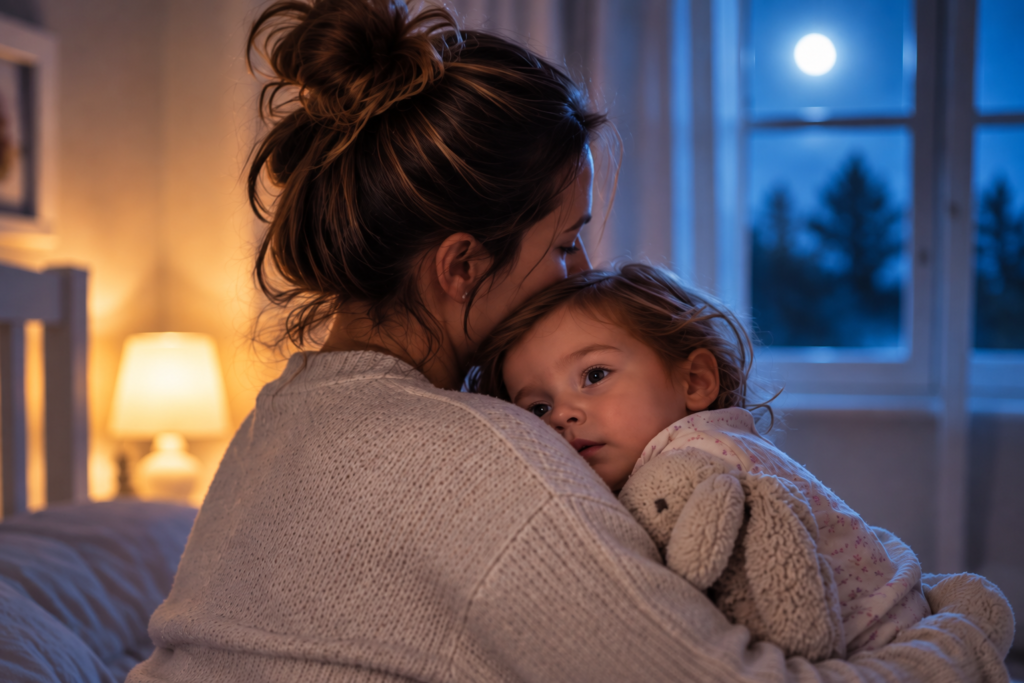
Yes. Night waking can be a completely normal part of childhood.
The NHS acknowledges that many young children experience difficulties settling to sleep and wake during the night.
One of the most helpful distinctions for parents is between waking and needing help to return to sleep.
Sleep isn’t one long, completely uninterrupted state. Children, like adults, move through different stages of sleep throughout the night and may briefly wake or become more alert between periods of sleep.
Some children move through these transitions without signalling for their parent. Others may cry, call out, feed, seek physical contact or need the conditions they associate with falling asleep.
And importantly, a child needing reassurance or closeness at night does not mean that you have done anything wrong.
The question I am more interested in when supporting a family is:
What might be contributing to this particular child’s night waking, and is it causing a problem for the child or family?
That moves us away from labelling a child as a “good” or “bad” sleeper and towards understanding what their sleep may be communicating.
Why Does My Child Keep Waking at Night?
There can be many reasons for frequent night wakings in babies and toddlers, and sometimes several factors overlap.
Here are some of the areas I consider when looking at a child’s sleep.
1. Hunger and Feeding
For babies, especially younger babies, waking to feed during the night can be developmentally appropriate.
Newborns have small stomachs and need frequent feeds throughout the day and night. Night feeding doesn’t automatically become unnecessary at a particular age because every baby’s growth, feeding and health circumstances are different.
The NHS also advises parents that, particularly in the early weeks, babies may fall asleep while being held and that keeping nighttime interactions calm and quiet can help babies gradually learn the difference between day and night.
If an older baby is waking very frequently and feeding at every waking, however, it can be useful to look at the bigger picture.
I might consider:
- how feeding is going during the day
- whether the baby is easily distracted during daytime feeds
- growth and development
- whether feeds appear substantial or very brief
- how the baby usually falls asleep
- whether there are any feeding or health concerns.
I would never recommend simply removing night feeds based solely on age.
If there are concerns around feeding, weight gain or whether your baby still requires night feeds, speak to your health visitor, GP or another appropriately qualified healthcare professional before making significant changes.
2. Your Child’s Daytime Sleep May Be Affecting the Night
Night sleep doesn’t exist separately from daytime sleep.
Naps, awake periods, activity and the timing of sleep all contribute to a child’s overall sleep pattern.
If a child has more daytime sleep than they currently need, they may not have enough sleep pressure at bedtime or during parts of the night.
But the opposite can also create difficulties.
A child who becomes extremely tired may find bedtime and overnight sleep more challenging.
This is why I don’t believe that simply keeping a baby or toddler awake for longer is the answer to night waking.
When I support families, I look at the whole 24-hour picture, rather than focusing only on what happens after bedtime.
This includes naps, morning waking, bedtime, developmental stage, activity, light exposure and the child’s individual sleep needs.
3. Bedtime May Need Adjusting
Sometimes the timing of bedtime is part of the puzzle.
A child may be going to bed before they have built sufficient sleep pressure. Another child may be reaching bedtime exhausted and struggling to settle calmly.
There isn’t one perfect bedtime that suits every baby or toddler.
Instead, bedtime should be considered alongside:
- your child’s age
- their nap pattern
- when their final nap ended
- their usual morning waking time
- their individual sleep needs
- how they behave around bedtime.
This is one reason generic sleep schedules found online don’t work for every child.
Your child’s sleep needs are individual.
4. Developmental Changes Can Disrupt Sleep
Sleep often changes alongside development.
Rolling, crawling, walking, language development and growing independence can coincide with changes in sleep. Toddlers also experience enormous emotional and cognitive development.
You might therefore notice a child who previously slept relatively predictably suddenly beginning to:
- resist bedtime
- wake more frequently
- call for you
- practise new skills in their cot
- wake earlier
- need additional reassurance.
Parents often refer to these periods as sleep regressions.
Rather than viewing a regression as your child’s sleep becoming “broken”, it can be more helpful to recognise that development isn’t linear.
Your child’s sleep can change as your child changes.
5. Separation Anxiety and the Need for Connection
A baby or toddler becoming more aware that you can leave is an important developmental milestone, but it can also bring a greater need for reassurance.
For some children, this becomes particularly noticeable at bedtime or during night wakings.
Your toddler might suddenly want you to stay beside their bed. Your baby might protest when you put them down. A child who previously settled relatively easily may start calling for you repeatedly.
Responding to your child doesn’t mean that you are creating a bad habit.
You can work towards better sleep while remaining responsive.
For some families, spending intentional connection time before bedtime, maintaining predictable routines and gradually making changes can help a child feel secure while developing new ways of settling.
This is central to my approach at Bluebell Sleep Consulting.
Better sleep and responsive parenting do not have to be opposites.
6. How Your Child Falls Asleep Can Matter
Sometimes parents are told that feeding, rocking, cuddling or lying beside their child is a “bad sleep association”.
I don’t believe it is helpful to label these things as bad.
If you enjoy feeding your baby to sleep and it works for your family, it doesn’t automatically need changing.
The question becomes different when a parent tells me:
“I don’t mind cuddling her to sleep at bedtime, but she now needs the same thing six times every night and I’m exhausted.”
In that situation, we can explore whether the child has developed a strong expectation around the conditions in which they fall asleep.
The goal does not have to be removing comfort.
Instead, it might involve gradually expanding the ways your child feels comfortable falling asleep, while continuing to offer reassurance and connection.
A 2026 systematic review examining behavioural sleep interventions for children aged 0–5 included 59 studies. The review found that parental guidance, bedtime routines, sleep hygiene and approaches relating to settling were common components, although the authors also highlighted that research has focused much more heavily on nighttime outcomes than daytime sleep.
This is another reason I prefer to look at the whole child and whole day rather than applying one technique to every family.
7. A Consistent Bedtime Routine May Help
Children often respond well to predictability.
A simple bedtime routine provides repeated cues that sleep is approaching.
Your routine doesn’t need to be complicated. It might look something like:
bath → pyjamas → milk/feed → teeth → story → cuddle → bed
The NHS recommends a calming wind-down period before bedtime for young children and suggests gradually adjusting its timing when necessary.
Research also supports bedtime routines.
A study by Mindell and colleagues involving 405 mothers and their babies or toddlers aged 7–36 months examined the effects of introducing a consistent nightly bedtime routine. After three weeks, the routine group showed improvements in several aspects of sleep, including sleep continuity and wakefulness after sleep onset. Maternal mood also improved.
A routine isn’t a magic solution to every night waking, but it can provide a valuable foundation.
8. Your Child’s Sleep Environment Could Be Contributing
Before making significant changes to the way a child falls asleep, I like to consider the simpler possibilities too.
Ask yourself:
Is their sleep environment comfortable and appropriate?
Light, noise, temperature and other environmental changes can sometimes contribute to disturbed sleep.
For babies, however, sleep environment isn’t simply about getting better sleep. Safety must always come first.
The Lullaby Trust recommends that babies sleep on their backs in their own clear, flat, firm sleep space and in the same room as their parent or carer for at least the first six months. It also advises avoiding overheating and gives 16–20°C as the recommended room-temperature range for babies.
Never compromise safer sleep recommendations in an attempt to encourage longer stretches of sleep.
9. Illness, Teething and Physical Discomfort
This is particularly important to me because of my paediatric nursing background.
Sleep isn’t always purely a behavioural issue.
When a child’s sleep suddenly changes, particularly if the change is significant, I think it is important to consider the child clinically as well as looking at their routine.
Illness, fever, congestion, pain, eczema or other discomfort can affect sleep.
Teething may also temporarily make some children more unsettled.
If your child’s frequent waking is sudden or accompanied by symptoms such as fever, breathing difficulties, unusual lethargy, persistent pain, feeding difficulties, reduced urine output, vomiting or anything else that concerns you, seek appropriate medical advice.
Sleep support should never replace medical assessment when a child may be unwell.
My nursing background has strongly influenced the way I approach sleep consulting. I don’t see sleep as an isolated behaviour that simply needs “fixing”. I look at the child as a whole, their health, development, feeding, environment, temperament, family circumstances and sleep patterns all matter.
10. Your Baby Waking Every Two Hours Doesn’t Necessarily Mean Something Is Wrong
One of the searches exhausted parents commonly make is:
“Why is my baby waking every 2 hours?”
The answer depends enormously on the baby’s age and individual circumstances.
For a young baby, frequent waking and feeding can be entirely expected.
For an older baby who previously slept for longer periods, I would want to know what else has changed.
Has your baby recently:
- learnt a new skill?
- become more mobile?
- experienced illness?
- started nursery?
- changed naps?
- begun eating differently?
- experienced separation anxiety?
- travelled?
- changed their bedtime?
- become increasingly dependent on one particular settling method?
Rather than immediately trying to eliminate the waking, look for the pattern.
That often gives us much more useful information.
What Can I Do About Frequent Night Wakings?
If your baby or toddler is waking repeatedly, start by observing before changing everything at once.
For several days, record:
- morning wake time
- naps and their duration
- bedtime
- approximately how long settling takes
- night waking times
- feeds
- how your child returns to sleep.
You may begin to notice a pattern.
Then consider whether there has been a recent developmental, environmental or family change.
Next, look at the basics: daytime sleep, bedtime timing, bedtime routine, feeding, activity, daylight exposure and sleep environment.
Make one or two gentle changes at a time rather than changing the entire routine overnight.
This also makes it much easier to understand what is actually helping.
When Should I Seek Medical Advice About Night Waking?
Not every sleep difficulty needs medical investigation. However, there are circumstances where speaking to a healthcare professional is important.
Seek medical advice if you are concerned about your child’s health or if sleep difficulties are accompanied by symptoms such as breathing difficulties, unusual snoring or pauses in breathing, significant pain, persistent vomiting, poor feeding or growth concerns, ongoing fever, extreme lethargy or anything that feels unusual for your child.
The NHS advises parents to seek medical advice when they are concerned that a baby is significantly unwell.
Your instincts and observations as a parent matter.
You Don’t Have to Choose Between Responding and Better Sleep
One of the reasons I became passionate about responsive sleep support is that parents are sometimes made to feel they have only two choices:
continue exactly as they are, despite being exhausted, or stop responding to their child.
There is a much bigger space between those two options.
You can comfort your child.
You can respond when they need you.
You can protect connection.
And you can still make thoughtful changes to support better sleep.
Sleep support should not be about forcing every child into the same schedule or method. It should be about understanding your child, what may be driving their sleep difficulties, and what feels right for your family.
When Personalised Sleep Support May Help
If you’ve tried adjusting naps, bedtime and routines but your child is still waking frequently, it can become difficult to know what to change next.
This is where personalised support can be valuable.
At Bluebell Sleep Consulting, I take a gentle, responsive and evidence-based approach to sleep. With my background in paediatric nursing and my training as a certified sleep consultant, I look beyond one isolated sleep problem and consider your child’s sleep within the context of their development, routine, health, temperament and family life.
There is no judgement and no one-size-fits-all approach.
If your child is waking repeatedly and you’re no longer sure what to change, you don’t have to try every sleep tip on the internet.
Together, we can look at your child’s sleep as a whole, identify what may be contributing to those wakings and create a gentle approach that feels manageable for your family.
Ready to understand what’s behind your child’s night waking? Book a free discovery call with Bluebell Sleep Consulting and let’s talk about what’s happening in your family.
Research and Evidence
At Bluebell Sleep Consulting, my approach is guided by current research, UK safer sleep recommendations and my paediatric nursing background.
Research shows that children’s sleep is influenced by many factors, including development, routines, sleep timing and individual sleep needs. Studies have also found an association between consistent bedtime routines and improved sleep outcomes, including fewer night wakings and longer sleep duration.
For babies, safer sleep must always come first. I follow guidance from The NHS and The Lullaby Trust, including recommendations around safe sleep spaces, positioning and temperature.
My nursing background has shaped the way I approach sleep. Rather than looking only at how to stop a child waking, I consider the whole child, including their health, development, feeding, environment and emotional needs.
NHS: Sleep and young children
NHS: Helping your baby to sleep
The Lullaby Trust: Safer sleep guidance
Mindell et al.: Bedtime routine study
2026 systematic review of sleep interventions in children aged 0–5(2026)
Please note: Sleep support does not replace medical advice. If you have concerns about your child’s health, breathing, feeding, growth or development, please speak to your GP, health visitor or another appropriately qualified healthcare professional.